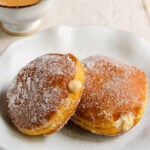
Pumpkin Brioche Donuts
Fluffy brioche pumpkin donuts filled with a seasonal pumpkin pastry cream.
Servings: 10 donuts
Equipment
- large heavy bottom pot
Ingredients
Pumpkin Brioche Dough
- 65 grams whole milk warm
- 7 grams instant dry yeast
- 50 grams granulated sugar
- 100 grams eggs room temp
- 120 grams pumpkin puree room temp
- ½ tsp vanilla extract
- 380 grams bread flour 12-12.7% protein
- 1.5 tsp pumpkin spice
- ½ tsp fine sea salt
- 100 grams unsalted butter cut into small cubes, softened
Pumpkin Pastry Cream
- 500 grams whole milk
- 80 grams egg yolks
- 120 grams granulated sugar
- 50 grams cornstarch sifted
- ½ tsp pumpkin spice
- 60 grams pumpkin puree
- 25 grams unsalted butter softened
- ½ tsp vanilla extract or vanilla bean paste
Oil For Frying
- 1000 grams vegetable oil or sunflower oil
Instructions
Pumpkin Brioche Dough
- In the bowl of a stand mixer, hand whisk together the milk, sugar, and yeast. Add in the pumpkin puree, eggs, and vanilla. Hand whisk just to combine.65 grams whole milk, 7 grams instant dry yeast, 50 grams granulated sugar, 100 grams eggs, 120 grams pumpkin puree, ½ tsp vanilla extract
- Next, dump in the flour, pumpkin spice, and salt.1.5 tsp pumpkin spice, ½ tsp fine sea salt, 380 grams bread flour
- Using the dough hook attachment on low speed, mix until a stiff thick bread dough is formed. (About 3-4 minutes on Speed 2 for my KitchenAid stand mixer.)
- Once the dough has come together, drop in the butter chunks, one at a time until fully combined into the dough. The texture will slowly go from stiff, to soft and sticky.100 grams unsalted butter
- After all the butter is added, increase to medium speed (Speed 4 on KitchenAid) until the dough becomes smooth, elastic and pulls away from the sides of the bowl. About 8 minutes. Scrape the bottom and sides of the bowl with a bowl scraper halfway through.
- At this point the dough should be clinginging to the dough hook and attached to just the bottom of the bowl. Looking like a slow orange dough tornado. It will be tacky, slightly shiny, and NOT super sticky.
- Remove the dough from the bowl, it should hold together in one large mass. Shape into a round ball and transfer to a large, lightly greased bowl.
- Cover the bowl with plastic wrap and let rest for 1-2 hrs until doubled in size
Pumpkin Pastry Cream
- Place the milk in a medium saucepan on medium heat. .500 grams whole milk
- In a large mixing bowl next to the stove, whisk together egg yolk and sugar until pale and foamy. Sift in the cornstarch, then whisk until smooth. Lastly whisk in the pumpkin spice and pumpkin puree.80 grams egg yolks, 120 grams granulated sugar, 50 grams cornstarch, ½ tsp pumpkin spice, 60 grams pumpkin puree
- Once the milk is steaming, slowly pour it into the egg pumpkin mixture while continuously whisking. Then, pour everything back into the saucepan and return to medium heat.
- Continue whisking until the custard thickens into a pudding-like texture. If you stop whisking you will see it boil, with a few burps of air. About 4-5 minutes.
- Remove from heat and stir in the softened butter and vanilla. Push the cream through a fine mesh sieve into a separate bowl. Place a sheet of plastic wrap directly onto the cream's surface to prevent a skin from forming. Refrigerate until thoroughly chilled, about 2-3 hrs.½ tsp vanilla extract or vanilla bean paste, 25 grams unsalted butter
Shaping and Frying Donuts
- Prepare two baking sheets by lightly greasing twelve squares of parchment paper with baking spray. Arrange the squares on the baking sheets.
- Slowly press your fist into the dough to release the gas and transfer to a lightly floured work surface. Roll out to rough circle about 1/2-inch thick.
- Take a 3.5-inch round biscuit cutter to cut out as many doughnuts as possible.
- Gather and re-roll the scraps to cut additional donuts. If the dough springs back while rolling, let it rest for 10–15 minutes before continuing. All this means is that the gluten bonds in the dough are tight and needs a little time to relax.
- Place each doughnut on a separate square of greased parchment paper, spacing them about 5 cm apart on the baking sheets.
- Loosely cover the baking sheets with plastic wrap. Let the doughnuts rise for about 60-90 minutes until puffy. A finger gently poked into the dough should fill back up slowly and leave a small indent. (It can take longer if your kitchen is cold.)
- While the donuts rise, prepare a cooling rack lined with paper towels next to the stovetop.
- Fill a heavy-based pot with about 2-3 inches of vegetable oil or sunflower oil. Heat the oil to 350°F (180°C ) using a thermometer to monitor the temperature.1000 grams vegetable oil or sunflower oil
- I recommend heating the oil on medium-high heat to get it to the right temp, then lowering it to medium to maintain. It may fluctuate as you fry the donuts, so keep an eye on the thermometer.
- Once the donuts have risen, carefully lift each doughnut by its parchment square. Gently lower it into the hot oil, then peel away the parchment with tongs once it releases from the dough. Take care not to deflate or misshape the doughnuts.
- Fry 2–3 donuts at a time, depending on the size of your pot. The doughnuts should float, with roughly half of each doughnut submerged.
- Fry for about 1-2 minutes, then carefully flip and cook for another 1-2 minutes, or until golden brown on both sides with a pale ring around the middle. The bubbles will subside when its ready to flip the doughnut.
- Keep an eye on the oil, if it gets too hot only the outside of the dough will cook and the inside will be gummy. To cold and the dough won't cook at all, but instead soak up a bunch of oil.
- Transfer the cooked donuts with a slotted spoon to a tray lined with paper towels to absorb excess oil. Let cool slightly.
- Carefully roll the both sides of the warm donut in a shallow bowl of granulated sugar for a light coating. Place on a plate or paper towel lined tray to cool completely.
Fill Doughnuts With Pasty Cream
- Remove pastry cream from the fridge and tranfer to a plastic piping bag fitted with a long piping tip.
- Poke a hole in the side of a donut, insert the piping tip and fill with pastry cream until you feel the donut becoming heavy and the cream starts to push back out.
- Brioche donuts are best enjoyed the day they're made. Serve immediately!