
This post contains affiliate links. Please see our disclosure policy.

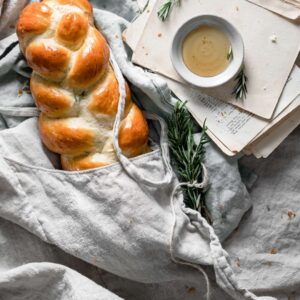
There’s nothing quite like the smell of fresh challah bread baking, but when you add rosemary and honey? Pure heaven. The woodsy herbs and sweet, tender crumb make this loaf feel extra special, yet it’s much easier to make than you’d think. This is the kind of bread that fills your whole home with comfort.


Don’t be intimidated by fresh bread, get excited! Playing with dough is going to be your new hobby. Think of this as a step up from your no-knead bread and an introduction into braided loaves.
Give yourself a free afternoon to experiment with how to make challah bread. You will have plenty of time to read, watch a movie, go for a walk, or have a meal while the bread is rising. But don’t eat too much, because once its baked you won’t be able to hold back.
Key Ingredients & Test Notes
- Honey: Adds natural sweetness and gives the challah its soft, tender crumb with a beautiful golden finish.
- Active Dry Yeast: Helps the dough rise into a light, fluffy loaf with that classic challah texture.
- Test Note: Make sure your water is around 110°F; too hot will kill the yeast, too cool will slow the rise.
- Olive Oil: Brings richness and moisture to the dough, creating a soft, supple texture.
- Test Note: A high-quality extra-virgin olive oil adds a subtle fruity note that pairs beautifully with honey.
- Eggs: Provide structure, richness, and the signature golden color of challah.
- Test Note: Room-temperature eggs blend more smoothly into the dough and help it rise more evenly.
- Bread Flour & All-Purpose Flour: This blend creates the perfect balance of strength and softness for an airy yet sturdy loaf.
- Test Note: If your dough feels too sticky, add 1–2 tablespoons of flour at a time until it’s manageable.
- Fresh Rosemary: It gives the bread a warm, woodsy aroma that’s cozy and unique.
- Test Note: Finely chop the rosemary so it disperses evenly.

How to Make Challah Bread
- Activate the yeast: In the bowl of a stand mixer, whisk together the warm water, honey, and yeast. Let sit for 8–10 minutes, until foamy.
- Mix the dry ingredients: In a separate bowl, whisk together the bread flour, all-purpose flour, salt, and finely chopped rosemary. Set aside.
- Start the dough: Attach the dough hook to your mixer. Add the beaten eggs to the yeast mixture and mix on medium-low. Pour in the olive oil and continue mixing until combined.
- Add the flour mixture: Gradually spoon in the dry ingredients while mixing on medium speed. Continue mixing until the dough pulls away from the sides of the bowl and forms a soft, slightly sticky dough.
- Knead the dough: Knead with the mixer on medium-high for 3–4 minutes (or knead by hand on a lightly floured surface for 6–8 minutes) until the dough passes the windowpane test.
- First rise: Place the dough in a lightly floured bowl. Cover loosely with plastic wrap and set in a warm, draft-free spot for 1–2 hours, or until doubled in size.
- Divide and rest: Transfer the dough to a floured surface and gently press out the air. Weigh and divide it into 6 equal portions. Roll each into a smooth ball, then let rest for 5–10 minutes.
- Shape the loaves: Roll three dough balls into 12–14 inch ropes. Braid them into a classic three-strand braid, tucking the ends under. Repeat with the remaining dough for a second loaf.
- Second rise: Place each loaf on its own parchment-lined baking sheet. Brush lightly with egg wash, then place in a cold oven with the light on to proof for 30–45 minutes, until puffy.
- Preheat the oven: Remove the loaves from the oven, brush again with egg wash, then preheat the oven to 350°F (180°C).
- Bake: Bake for 45–50 minutes, until the loaves are golden brown, reach 190°F internally, or sound hollow when tapped on the bottom. Rotate halfway if browning unevenly.
- Cool and serve: Place the baking sheets on a cooling rack and allow the loaves to cool for 10–15 minutes before slicing.
Helpful Tips
- Proofing made easy: If your kitchen is chilly, let the dough rise in the oven with just the light on. The gentle warmth creates the perfect proofing environment.
- Mix flour slow: Adding the flour mixture a little at a time helps the dough stay tender and prevents overworking.
- Weigh for even braids: After the first rise, weigh your dough and divide evenly. This ensures your braided strands bake uniformly.
- Let the dough grip the counter: Keep your work surface only lightly floured. A little grip helps you roll smooth, even strands.
- Adjust dough texture with your hands: If the dough feels sticky when rolling, dust your hands with flour. If it feels dry, lightly wet your hands to bring back elasticity.
- Prevent sticking as you braid: Once the strands are rolled out, sift a tiny bit of flour over them. This keeps them from sticking together while braiding.
- Use a soft pastry brush for egg wash: A gentle brush prevents deflating the beautifully risen dough and gives a glossy, even finish.
- Check for doneness the baker’s way: The loaf is ready when the center reaches 190°F. You can also lift and tap the bottom, if it sounds hollow, it’s done.

Storage & Leftovers
- Room Temperature: Store your challah in a sealed paper bag at room temperature for up to 3 days to maintain its tender crumb and soft crust.
- Freezing: Wrap the fully cooled loaf tightly in plastic wrap, then foil. Freeze for up to 3 months. Thaw at room temperature before slicing.
- Rewarm Like Freshly Baked: Lightly toast or warm slices in a 300°F oven for 5–7 minutes to bring back that just-baked texture and flavor.
★★★★★ Please leave a star rating and review below if you make this recipe! THANK YOU!!
Rosemary Honey Challah Recipe
Ingredients
Challah Bread Dough
- 1 Cup (125 ml) Warm Water, 110 F
- 4 Tbsp Honey
- 2 1/4 tsp Active Dry Yeast
- 1/4 Cup (62.5 ml) Olive Oil
- 2 (100 grams) Large Eggs
- 2 Cups ( 250 grams) Bread Flour
- 2 1/2 Cups ( 312.5 grams) All Purpose Flour
- 2 tsp Kosher Salt
- 1.5 Tbsp Fresh Rosemary, finely chopped
Egg Wash
- 1 (50 grams) Large Egg, beaten with a fork
Instructions
- In the bowl of a stand mixer combine yeast, warm water and honey. Stir with a hand whisk and let sit 8-10 minutes until frothy.
- Meanwhile in a large bowl hand whisk together sifted flours, salt, and rosemary. Set aside.
- Place dough hook attachment on mixer.
- Add beaten eggs to yeast mixture and begin to mix on medium low.
- Pour in the olive oil and mix until combined. Gently scrape bottom of bowl if needed.
- Slowly spoon in flour mixture while continuing on medium speed.
- Mix until dough has formed and pulls away from edges of bowl wrapping around dough hook, but still attached to very bottom center of bowl. Dough should be slightly sticky and firm.
- Now, either work dough for 3-4 minutes on medium high speed until a positive 'Windowpane Test' is performed,(pull a piece of dough off with fingers and spread apart, if can be stretched to transparency without breaking gluten is ready).. Or transfer to lightly floured surface and knead by hand for another 6-8 minutes.
- Place dough in a lightly floured bowl large enough for dough to double. Cover loosely with plastic wrap and set in a warm draft free location.
- Dough will need 1-2 hrs to prove and double in size.
- Once doubled in size transfer dough to a lightly floured surface. Press risen dough down to release excess air.
- Weigh the dough and using a sharp knife or bench scraper, cut into 6 equal portions.
- Take each portion and roll onto slightly grippy surface with a cupped hand to make a smooth round ball.
- Let dough balls rest for 5-10 minutes.
- Take three balls and roll out into equal length 12-14 inch strands. Place the three strands onto a parchment paper lined baking sheet. (You can also braid on the counter and then transfer to tray.)
- Attach the tips furthest from you by pressing together with fingers and rolling the tips into a point. Braid dough in a three strand french braid completely to the end. Press remaining tips together like the top. Tuck each end slightly under the loaf. Transfer to tray if not already done.
- Gently coat the loaf in egg wash and set in cold oven with light on for second prove. Repeat with second set of dough. Each loaf should be on its own baking sheet.
- Allow braided loaves to prove and puff for 30-45 minutes.
- Remove loaves from cold oven and place on counter for second coating of egg wash.
- Meanwhile preheat oven to 350 F (180 C).
- Place loaves on middle rack and bake for 45-50 minutes until golden brown, 190 F in center, and/or hollow sounding when tapped from the bottom.
- If loaves are browning too much on one side rotate halfway through baking.
- Place baking sheets on cooling rack and allow bread 10-15 minutes to cool before slicing and serving.

This is my go to challah base recipe. I use this as the base for any challah I make and it’s absolute perfection! I don’t regularly have bread flour so I weighed out the combined APF and bread flour and then I kneaded longer to develop gluten structure. It is perfect every time. I’ve been using this recipe for years, and I always come back to it because it’s the best. Last night I used it to make three different styles savory and sweet. Thank you for this recipe it’s now a staple!
Thank you so much for the feedback Shanny! I’m so glad you love this bread! It’s one of my favorites as well.
I loved this bread!! It was so yummy 🙂
Would it turn out the same if I used only all purpose flour and no bread flour?
Greetings! I’ve been reading your blog for a
long time now and finally got the courage to go ahead
and give you a shout out from Houston Texas! Just wanted to say keep up the good job!