
This post contains affiliate links. Please see our disclosure policy.
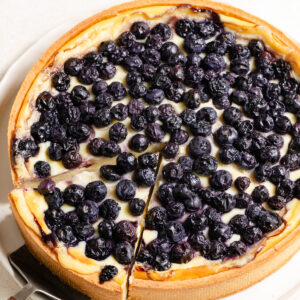
My creamy French blueberry flan tart is everything you love about cheesecake, only lighter, silkier, and even more irresistible. Better yet, there’s no water bath required. A velvety vanilla bean custard is baked inside a buttery, golden shortcrust pastry shell and topped with juicy blueberries.

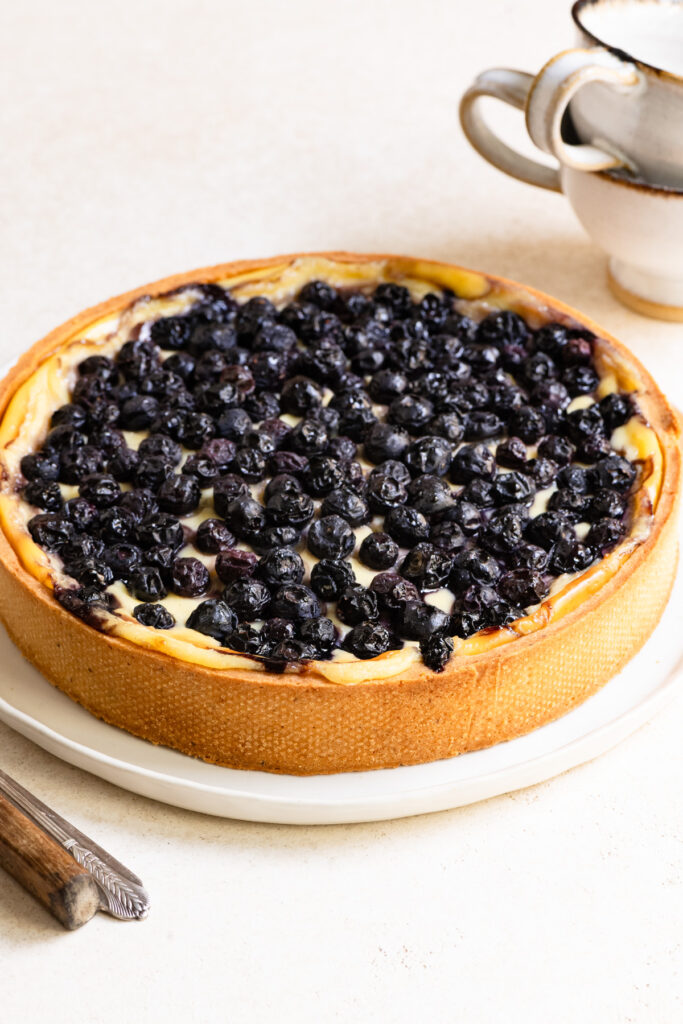
It’s inspired by the classic French flan pâtissier (also known as Parisian flan), with its cornstarch-thickened vanilla custard baked in a pastry crust. But this version celebrates summer with plenty of fresh blueberries. The top won’t have a flan’s characteristic darkened top skin due to the berry topping.
In French pastry school, I made individual flans tucked into pâte sucrée with tall custard fillings and deeply caramelized tops. For this seasonal take, I opted for a slightly wider, shallower tart so the blueberries can cover the surface, releasing their juices into the custard as it bakes for a dessert that’s as beautiful as it is delicious.
Key Ingredients & Test Notes
- Pâte Sucrée – Sweet Pastry Dough: The tart crust is made out of an almond shortcrust pastry dough that’s partially baked for a crunchy golden cookie-like texture.
- Test Note: I like to make the pastry dough a day ahead to give it plenty of time to rest in the refrigerator. Then I line a perforated tart ring and freeze it completely before par-baking.
- Whole Milk and Heavy Cream: Whole milk forms the base of the custard and the heavy cream adds richness. This balance creates a classic French flan with a smooth, creamy texture that never feels too dense.
- Eggs and Yolks: I use a combination of whole eggs and yolks for the perfect balance of structure and richness. Tempering the eggs with the warm dairy ensures a smooth custard. While cooking the mixture activates the starch and thickens the filling.
- Cornstarch: Unlike an English custard tart, flan pâtissier also uses cornstarch to thicken the filling. The starch creates a custard that’s sturdy enough to hold its shape without sacrificing its mouthfeel.
- Test Note: Make sure to sift the cornstarch to prevent having a lumpy cream!
- Whisk the cornstarch thoroughly into the eggs and sugar before tempering. Keep the custard moving with constant whisking as it cooks to prevent lumps.
- Blueberries: For a jammy, chunky blueberry topping, I add the berries just before popping the tart in the oven.
- Test Note: Macerate the berries first for about 15 minutes with a splash of lemon juice and granulated sugar to help soften them.
How to Make a French Blueberry Flan Tart

- Roll out one half of the pastry dough to 1/8–1/4 inch (3–4 mm) thick. Cut out a circle using the tart ring, then chill until firm.
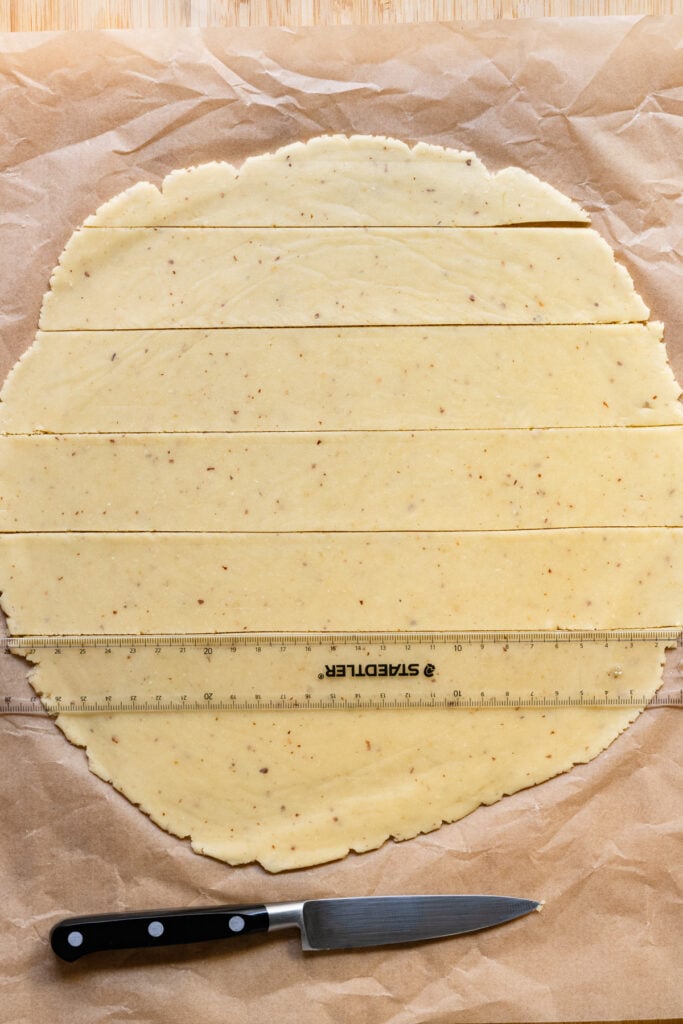
- Roll out the remaining dough to the same thickness. Cut strips slightly wider than the height of the tart ring. Chill the strips before lining the tart ring.
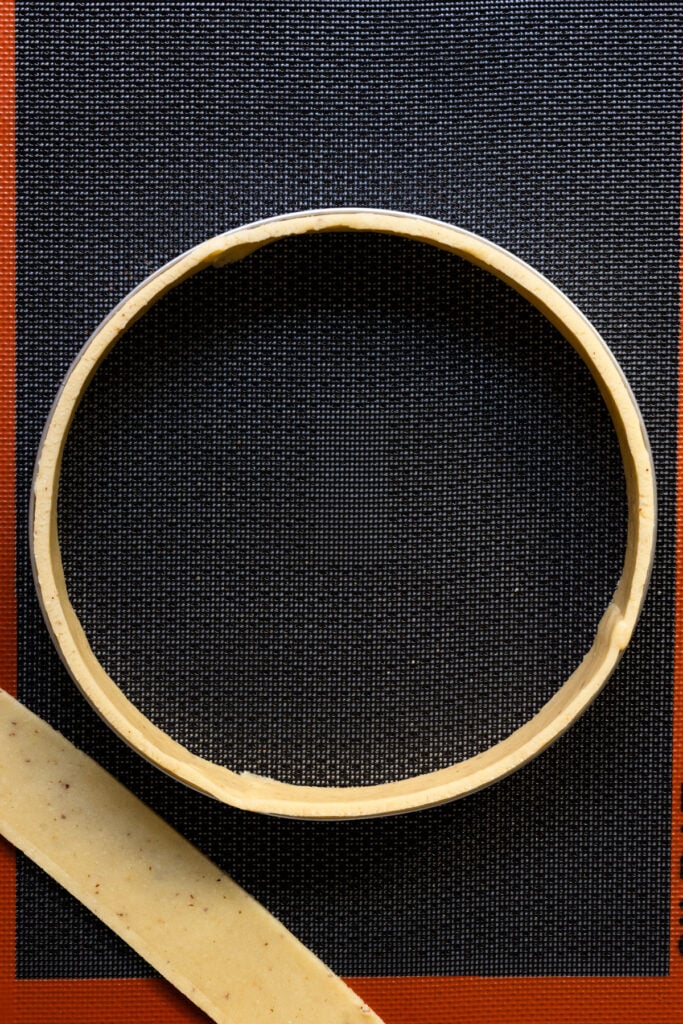
- Line the inside of the tart ring with the chilled strips, sealing any overlaps with your fingertips. Press the dough into the corners and against the sides of the ring to ensure a snug fit.
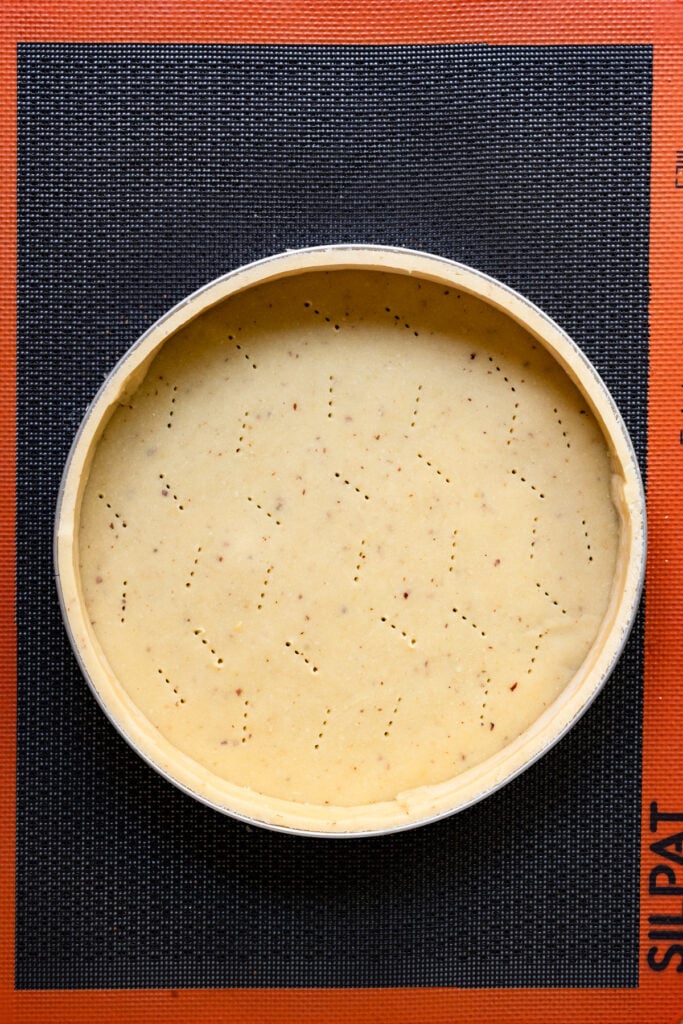
- Press the lined tart ring onto the base to seal, dock with a fork, trim the excess, and freeze until firm.
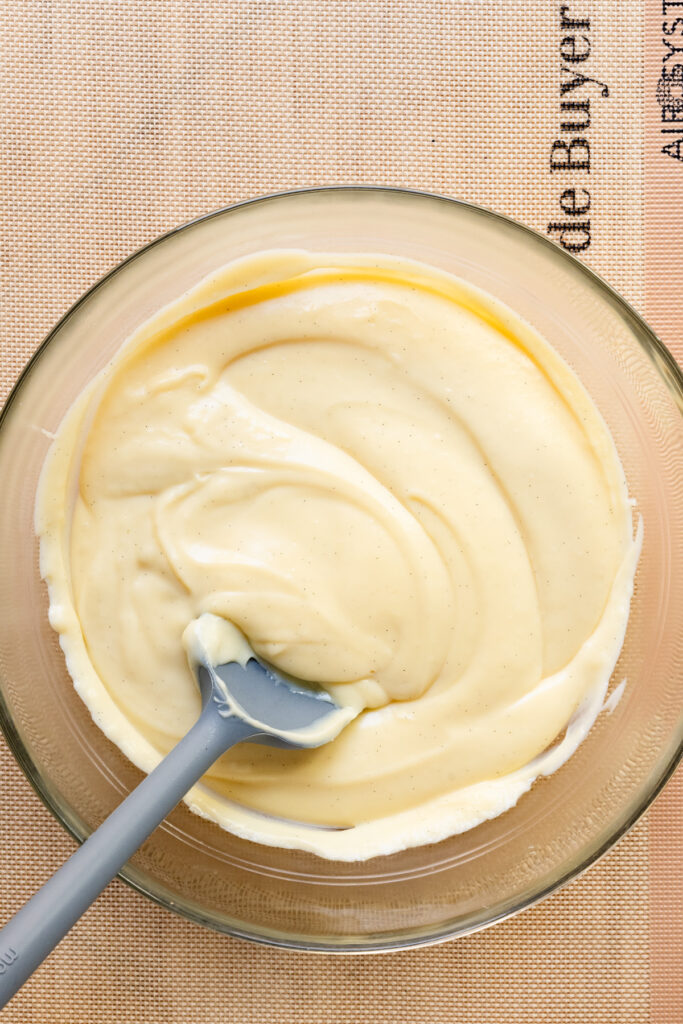
- Make the pastry cream, cover with plastic wrap pressed directly onto the cream, then chill until cooled.
- Par-bake the tart shell at 375°F (190°C) conventional or 340°F (170°C) fan for 18–20 minutes, until lightly golden. Cool completely.
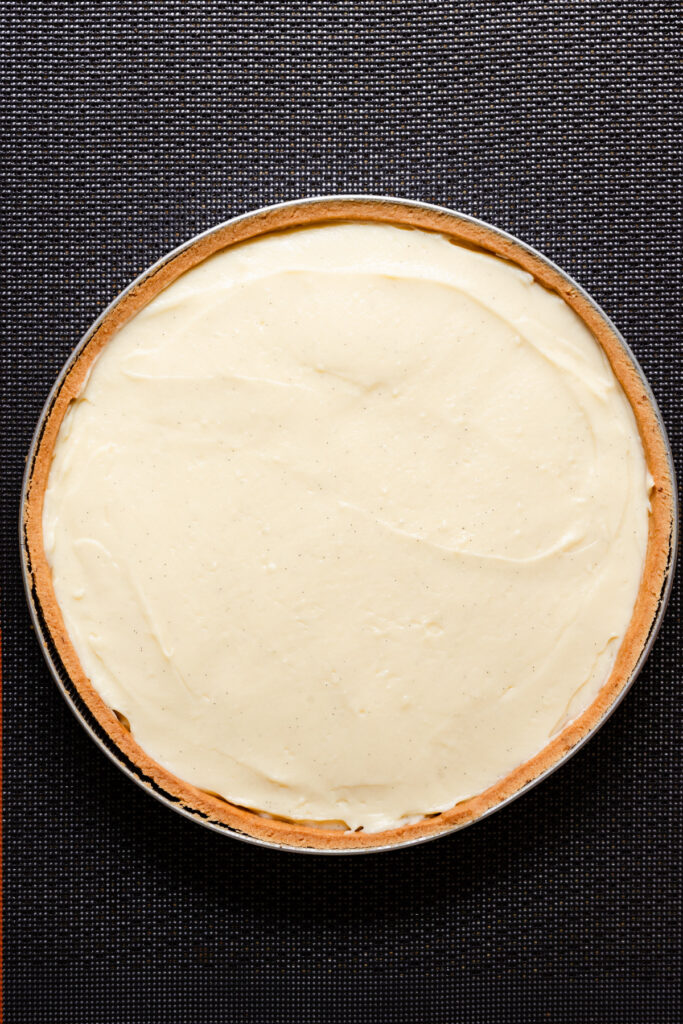
- Fill the cooled tart shell with the cooled pastry cream, leaving a little room at the top for it to puff as it bakes.
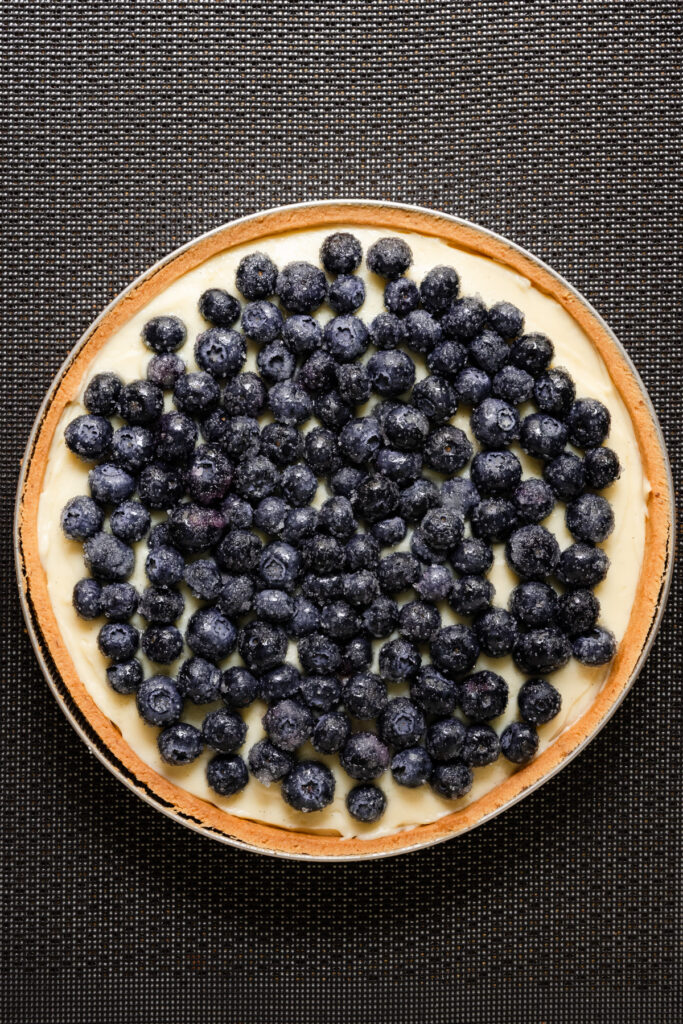
- Top the cream with sugar coated blackberries, leaving a 1/2 inch border from the crust. Bake until the custard has puffed and turning golden on the edges.
Jenn’s French Flan Tips
- Pre-bake the Crust: Most classic flan pâtissier recipes call for pouring hot custard into a frozen tart shell, freezing it again, and then baking everything together. I found that method less reliable as the hot cream will have an effect on the sturdiness of the frozen pastry shell.
- Crusts without a partial bake also tend to be paler, softer, and more likely to stick to the tart ring. This makes them harder to unmold without breaking.
- So instead, I partially bake my crust, let it cool, then fill it with cooled pastry cream before baking the tart. This extra step produces a crisp, deeply golden crust that’s much easier to remove from the pan.
- Make Ahead:
- Pate Sucrée: The tart dough can be divided, wrapped in plastic film and refrigerated for up to 3 days.
- Once the tart ring is lined it can be frozen overnight as well, which helps prevent shrinking while pre-baking.
- Flan Cream: To save a bit of time, the pastry cream can be made the day before and stored in the fridge. Whisk well with a hand whisk to smooth it out before adding to the tart shell and baking.
- Pate Sucrée: The tart dough can be divided, wrapped in plastic film and refrigerated for up to 3 days.
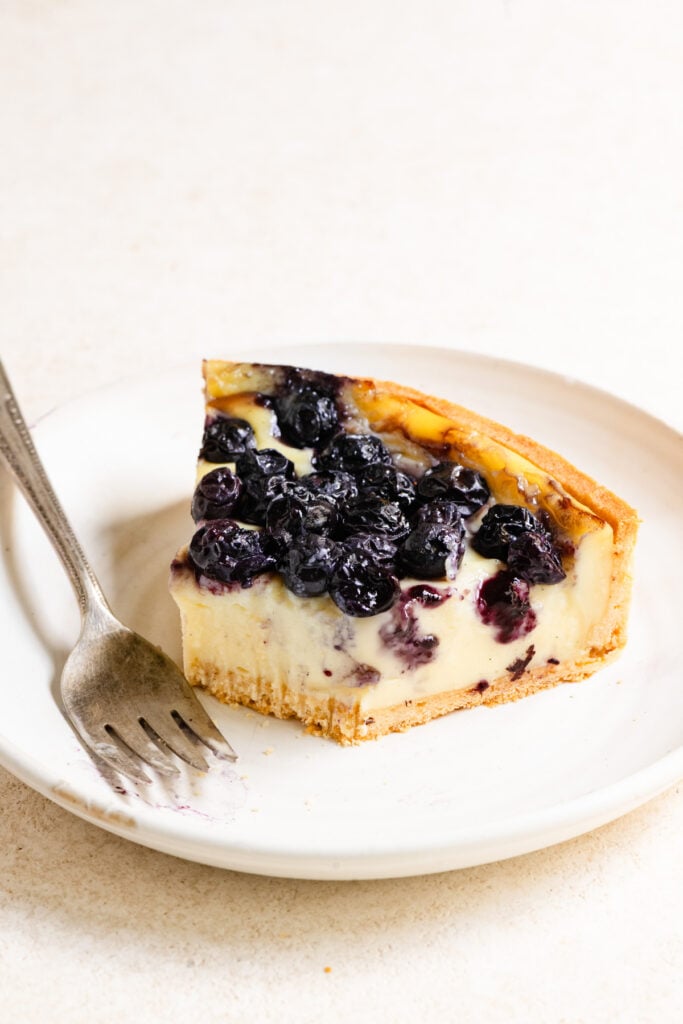
- Storage: After the baked flan tart has cooled to room temp, it will need to be chilled overnight (at least 6 hrs) before serving. Keep it in an airtight container in the fridge for up to 4 days.
★★★★★ Please leave a star rating and review below if you make this recipe! THANK YOU!!
French Blueberry Flan Tart
Equipment
- medium saucepan
- perforated silicone baking mat optional
- perforated baking tray optional
Recipe Video
Ingredients
Pastry Crust
- 1 batch Sweet Tart Pastry – Pâte Sucrée
Flan Custard
- 600 grams whole milk
- 150 grams heavy cream , 33-35% fat
- 1 Tbsp vanilla bean paste of 1 vanilla bean scraped
- 165 grams granulated sugar
- 100 grams (2 large) whole eggs
- 80 grams (4 large) egg yolks
- 60 grams cornstarch, sifted
Blueberry Topping
- 300 grams (2 cups) fresh blueberries
- 1 tsp lemon juice
- 2 Tbsp granulated sugar
Instructions
Pastry Crust
- Make a batch of pate sucrée at least 2 hours before you want to assemble the tart. Divide the dough in two halves, shape into discs, cover in plastic wrap and refrigerate for a minimum of 1 hour. (I usually make mine the day before.)1 batch Sweet Tart Pastry – Pâte Sucrée
Line the Tart Ring
- I am using a French style tart ring that is 22cm x 3.5cm. But you can use a 9-inch (22cm) fluted tart pan that is 1.5 inches (3.5 cm) deep.
- Roll out one half of the pastry dough to 1/8–1/4 inch (3–4 mm) thick. Place the tart ring on top and cut out a circle for the tart base. Remove the excess dough and chill the pastry circle in the refrigerator until firm.
- Take the second half of the dough and roll it out to the same thickness as the base. Using a ruler, cut strips slightly wider than the height of your tart ring. For a 22cm × 3cm tart ring, I cut the strips 4cm wide. Transfer the strips to the refrigerator to chill until firm before using them to line the tart ring.
- Line the inside of the tart ring with the chilled strips, sealing any overlaps with your fingertips. Press the dough firmly into the corners and against the sides of the ring to ensure a snug fit and straight, even edges.
- Place the tart base on a perforated silicone mat set on a baking tray. Position the lined tart ring over the base and press down firmly to seal. Dock the base with a fork, then trim any excess dough with a small knife. Freeze the tart shell until completely firm before par-baking. (1-2 hrs or even better overnight)
Par-bake the Crust
- Preheat a conventional oven to 375°F (190°C), or if using convection fan oven 350°F (170°C).
- Bake the empty tart shell for 18-20 minutes until lightly golden in color. Set the pan on a cooling rack and let the crust cool completely. Do not remove the tart ring or tart pan.
- ~If the dough is properly lined, there's no need for parchment paper or baking weights. However, if you're new to using a tart ring or prefer extra insurance, line the frozen tart shell with parchment paper and fill it with pie weights, dried beans, or rice. Bake 15 min. with weights and 3-5 min. without.
Flan pastry cream filling
- Set up your work station so everything is laid out and next to the stove to make things easier and less stressful for you. Place an empty bowl on the counter close by.
- Stir together the milk, cream, half of the sugar, and vanilla in a large saucepan on medium heat.600 grams whole milk, 150 grams heavy cream , 1 Tbsp vanilla bean paste of 1 vanilla bean scraped, 165 grams granulated sugar
- ~Option to bring the mixture to simmer, cover with plastic wrap and let steep for an hour for a more intense vanilla flavor. But you can skip this and the flan will still taste amazing.
- Meanwhile in a large mixing bowl hand whisk together the eggs, yolks, and remaining half of the sugar into a thick liquid. Use a little elbow grease and whisk in the sifted cornstarch until completely dissolved into a smooth mixture.100 grams whole eggs, 80 grams egg yolks, 60 grams cornstarch
- Once the milk and cream reach a simmer, slowly pour half into the eggs while continuously whisking to temper the mixture.
- Now pour the egg mixture back into the saucepan while stirring on medium heat.
- Continuously whisk as the custard starts to thicken. This will happen pretty quickly in just a minute or two. It's important to keep whisking to prevent a lumpy custard.
- As it thickens it will come to a boil. You'll notice it's ready when you stop whisking and the mixture kind of burps up a few air pockets. Whisk vigorously for a smooth glossy pastry cream and then remove from the heat.
- Transfer the pastry cream to a heat proof bowl, place a sheet of plastic film directly on the surface and refrigerate until cool.
Assemble & Bake
- Toss the blueberries with a little lemon juice and sugar in a small bowl until well coated. Set aside.300 grams fresh blueberries, 1 tsp lemon juice, 2 Tbsp granulated sugar
- Preheat a conventional oven to 375°F (190°C), or if using convection fan oven 350°F (170°C).
- Whisk the cold pastry cream a few times by hand to smooth it out.
- Fill the partially baked tart shell with the pastry cream, but leave a little room for it to puff in the oven. You may have a little cream left over.
- Level with an offset spatula. Cover the pastry cream with the sugar coated blueberries. Leave a bare border about 1/2 inch wide of pastry cream next to the crust. Gently pat the berries into the cream.
- Bake the flan tart on the middle oven rack for 40-50 minutes. The filling will puff up near the crust and begin to brown slightly. The berries will shrivel and leak their juice across the top. If you wiggle the flan it should have a slight wobble to the center, similar to cheesecake or pumpkin pie.
- Place the pan on a wire to cool completely (3-4 hrs.). The flan will set more firmly as it cools. Leave it in the tart ring or pan.
- Transfer the cooled flan to the fridge to set overnight or a minimum of 6 hrs. When it has completely set, you can remove the tart ring or tart pan before serving.
- If the tart crust is slightly attached to the ring or tart pan, you can run a small sharp knife around the edge to loosen it.
Notes
- Oven Settings: I really like the even bake the fan oven gives the outer crust. While a conventional oven with top and bottom heat will break down the blueberries on top a bit more.
- Skipping the par-baked crust?: While it is possible to fill the frozen tart shell with the cooled pastry cream and bake without partially baking the crust, it’s not ideal. The tart crust won’t be quite as crisp or as uniformly baked. If you do this I would start with the oven 25 degrees higher for the first 10 minutes to help set the pastry.
- Leftover Custard: Depending on how thin your crust is, what pan you use, and if the crust shrinks at all, you may or may not have a little leftover pastry cream.
- Use it to dollop on anything! Cake, granola, etc.
- Eat it with a spoon!
- Fill small small ramekins and bake for 15-20 minutes at 375F (190C) conventional oven.

Well, Jenn, I finally made this today. I haven’t been able to sample taste it yet, waiting for the cool down. It was an education made easier by your recipe. It helps that you provide weights for ingredients, something a few well known cook shows still don’t do. And you provide them by step, additionally helpful.
I made a few missteps. The shell could be better. I failed to sift the pastry cornstarch, which made the cream lumpy, but passing it through a sieve fixed that. And for some reason baking for just 40 minutes managed to overcook the filling. Yadda yadda.
I’m looking forward to trying it. The pastry cream turned out great, and I had leftovers!
Hi Gordon! Thanks for giving this a go! I’ve thought about doing away with providing cup measurements all together, as I test everything in grams and its much more accurate. How can I help with the shell? I find it easier to work at 1/4 inch thickness, and if its pressed into the ring nicely I don’t use pie weights. I think the parchment paper sometimes ruffles up my crust. But when I use a tart pan it’s fine, I like perforated tart pans too.
Ah yes, sifted cornstarch is a must. But glad the sieve helped, it’s a lifesaver.
How did the filling overcook? Did it crack when cooled or bubble up on the edges and brown? The latter is normal. The top layer won’t be smooth like a cheesecake but the filling should be nice and creamy. I know some people like a super soft almost spoonable flan and others a more Mexican flan texture. I’m in the middle 🙂
For extra pastry cream, there will be a little left over depending on the height of the tart ring/pan and how thin or thick the crust is. I had a bit leftover that I ate with a spoon while my flan baked.
Happy to help troubleshoot or add more details if needed. Thanks again for the feedback!