
This post contains affiliate links. Please see our disclosure policy.
Lemon basil ice cream delivers a smooth, creamy texture with bright lemon flavor and a subtle hint of basil. It’s just what you need to cool your HOT self down! Grab fresh basil, a few lemons, cream, milk, sugar, and vanilla. Pop your ice cream machine bucket into the freezer now so it’s ready when the base has chilled.
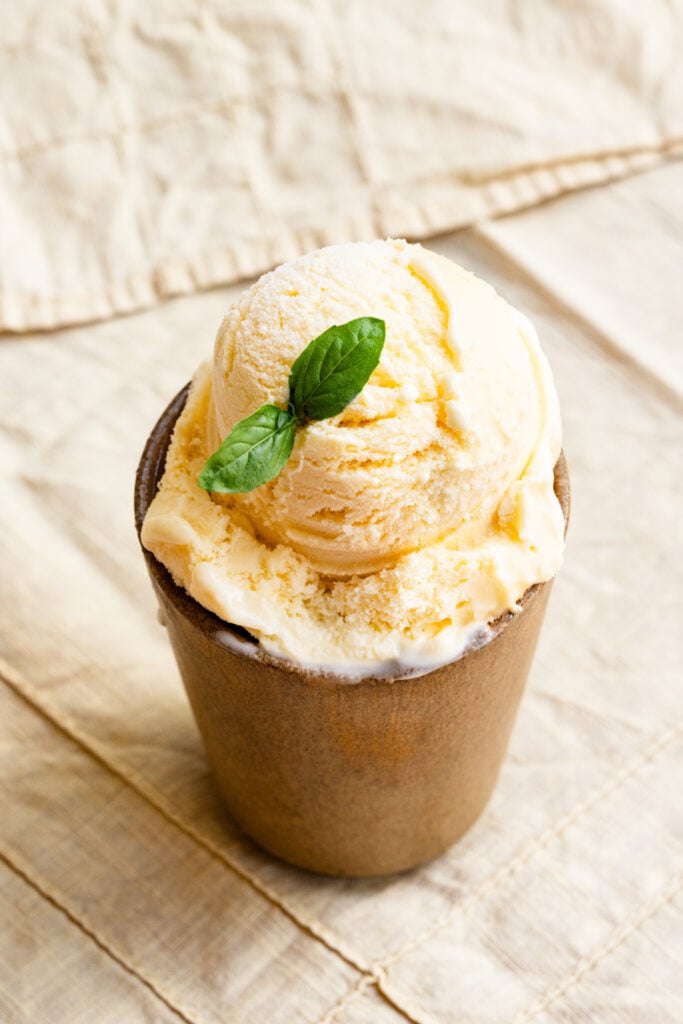
Making Homemade Ice Cream
I prefer to use a thermometer and rest my homemade ice cream base overnight. This is how I was trained to make ice cream at French pastry school to ensure a fabulous texture. Steep the basil in the dairy first then remove it, for little green bits you can blitz a few fresh leaves in with a blender before churning.
On the note of curdling dairy with citrus, I’ve tested adding the lemon juice to the base in two different ways. Pouring a lemon syrup into the machine while the base is churning, or just stirring the plain lemon juice directly into the base before chilling. My tests have not curdled and both have a delicious lemon flavor.
Important facts about homemade ice cream..
- Leftover Egg Whites: Separating eggs is part of the process. Since you’ll be using just the yolks, there will be 6 leftover egg whites. Put them in a container with a lid in the fridge and use them for pavlova or Swiss meringue buttercream.
- Ice Cream Machine: You’re gonna need an ice cream machine to churn the base. For a great texture and actual real ice cream, stirring isn’t gonna cut it.
- Chill Time: Good things come to those who wait right? A night in the fridge is exactly what this custard based ice cream needs to chill properly for churning and ‘ripen’ its flavors.
Key Ingredients
- Heavy Cream (32–35% fat): Higher fat ice cream is richer and more luxurious.
- Whole Milk (at least 3.6% fat): Balances the richness of the cream while keeping the custard smooth.
- Granulated Sugar: While honey brings moisture and a complex floral sweetness, granulated sugar helps stabilize the egg yolks during tempering and contributes to the overall creaminess by lowering the freezing point.
- Honey: Adding natural sweetness, this invert sugar, helps to inhibit crystallization, resulting in a scoopable ice cream that doesn’t freeze into a solid block.
- Large Egg Yolks: Adding extra egg yolks to this custard base works like a stabilizer to prevent crystallization.
- Lemon Syrup: A homemade tart lemon syrup creates the bold lemon profile of the ice cream.
- Fresh Basil: Steeping the milk and cream with the basil, infuses a soft basil flavor to the ice cream, without overpowering the lemon.
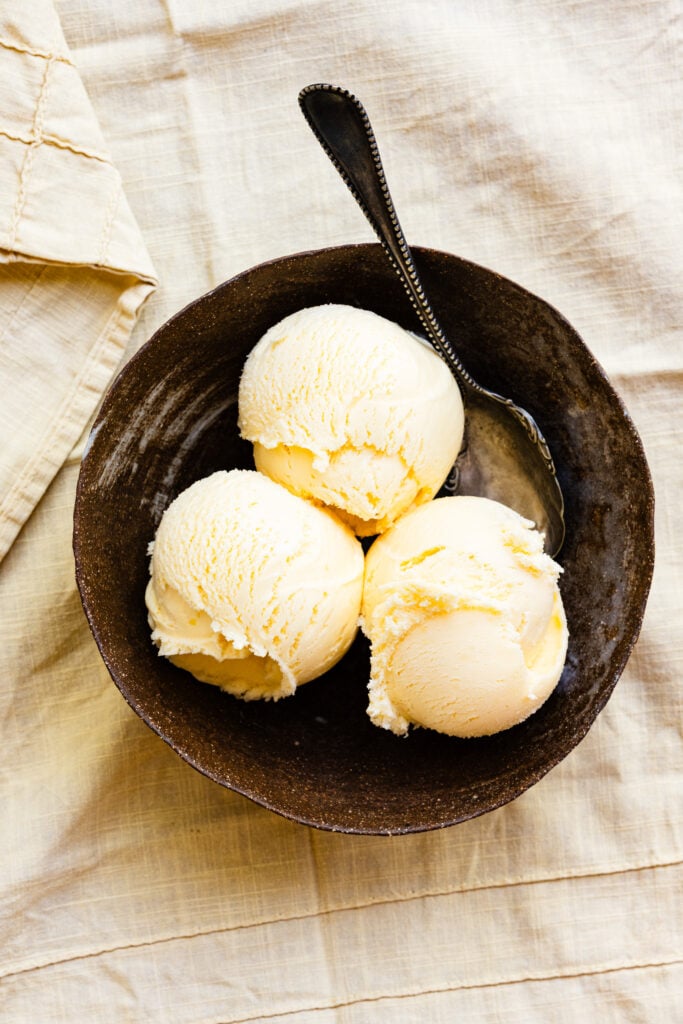
Jenn’s Ice Cream Tips
- Just the Zest, not the pith: Focus on removing just the thin yellow outer peel. If you dig too deep into the white pith with the microplane, it’ll bring a sharp, bitter flavor that doesn’t belong in your ice cream.
- Use a Thermometer: At French pastry school, I was taught to always brought the cream and milk to 113°F (45°C) before adding the sugar, Then tempering the eggs, and heating the mixture up to 183°F (85°C) to make them safe for consumption. Don’t rely on thickness as your cue, temperature is what matters here.
- Strain If Needed: If you accidentally cook your base a little too much, you may have some egg bits. These are easily removed by pouring the base through a fine mesh sieve.
- Chill Overnight: A minimum of 4 hours chilling is required before churning, but an overnight rest in the fridge is the best option. This allows the base to chill sufficiently so it will freeze faster into a soft serve while churning. It also helps develop a deeper lemon flavor for the final ice cream.
- A Quick Blend: Before churning, give your chilled ice cream base a quick blitz with an immersion blender. This extra step helps everything come together smoothly and ensures a well emulsified, creamy finish.
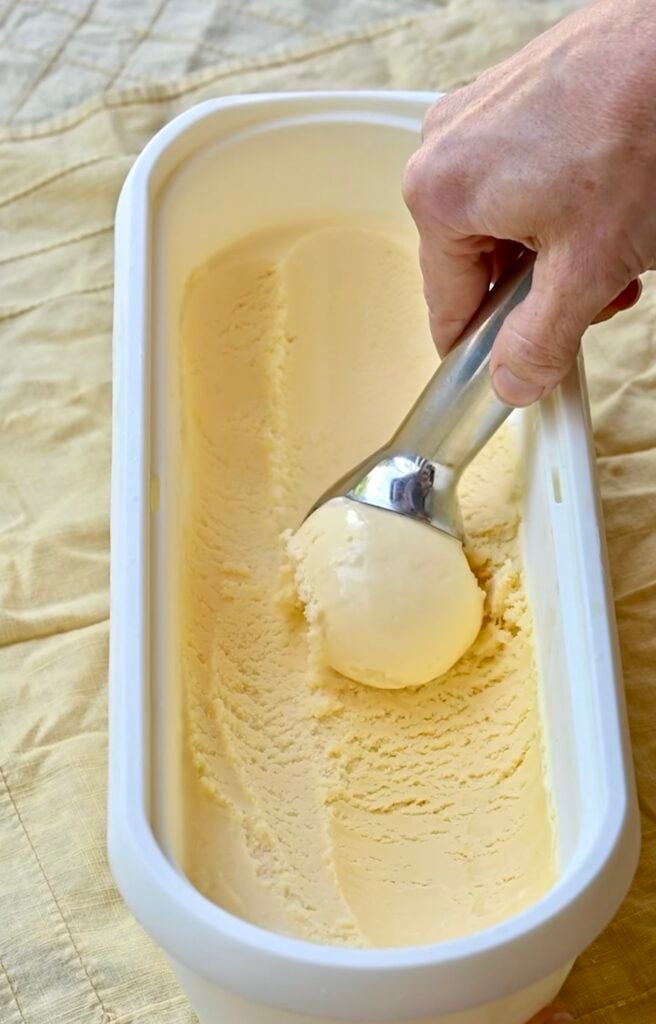
Leftovers & Storage
Store ice cream in an airtight freezer safe container, I love using my Tovolo Ice Cream Tub. Homemade ice cream without the use of commercial stabilizers is best eaten with 2-3 days of making. It can last up to 2 weeks in the freezer, but will slowly become firmer.
Lemon Basil Ice Cream
Ingredients
Lemon Syrup
- 160 grams (⅔ cup) fresh lemon juice
- 2 tablespoons granulated sugar, don’t need if just using lemon juice
Ice Cream Base
- 133 grams (⅔ cup) granulated sugar
- 500 grams (2 cups) heavy cream, 33-35% fat
- 250 grams (1 cup) whole milk
- 2 tablespoons honey
- 1 bundle (1 ½ cups) fresh Basil leaves, packed and no stems
- 3 tablespoons finely grated lemon zest, divided
- 100 grams (5 large) egg yolks
- 1.5 teaspoons vanilla extract
- pinch of flaky sea salt
Instructions
Lemon Syrup
- Place lemon juice and sugar in a small saucepan and bring to a simmer over medium heat, stir until the sugar is dissolved. Remove from the heat and refrigerate the thin syrup until chilled.160 grams fresh lemon juice, 2 tablespoons granulated sugar
Steep the Basil
- Add the milk, cream, and honey in a medium heavy bottom saucepan, bring to a soft boil. Remove pan from the heat, stir in the basil leaves, and 2 tablespoons of lemon zest. Cover the pan with plastic wrap to trap the steam. Let steep for 30 minutes to hour.500 grams heavy cream, 250 grams whole milk, 1 bundle fresh Basil leaves, 3 tablespoons finely grated lemon zest, 2 tablespoons honey
Make Ice Cream Base
- Set a mesh wire sieve over a large bowl, near the stove.
- Place the egg yolks in a medium bowl, whisk well and set them next to the stove.100 grams egg yolks
- Scoop the basil out of the cream with a slotted spoon and return the sauce pan to medium heat, stirring occasionally.
- When the temperature of the cream reaches 113℉ (45℃) on instant thermometer, stir in the sugar. Followed by slowly pouring in the egg yolks while continuously whisking.133 grams granulated sugar
- TIP: The temperature is low enough that the eggs can be tempered directly into the sugared cream. OR you can ladle out 1 cup (250 grams) of the hot cream and slowly drizzle it into the bowl of yolks while whisking, then pour that mixture back into the saucepan while whisking to temper the eggs.
- Now that the egg yolks have been added to the cream, continue to gently stir while cooking the custard base until it reaches 182℉ (83℃) on the thermometer.
- The ice cream base is cooked when it reaches the desired temperature, when it coats the back of a spoon and you can easily draw a line through the custard with your finger tip.
- Immediately remove the pan from heat and strain the custard through a wire mesh sieve into a large bowl to catch any leftover zest or possible cooked egg.
- Stir in the salt, vanilla and extra tablespoon of lemon zest. Let the base cool at room temperature, with an occasional stir. (stir in the lemon syrup or wait until churning)1.5 teaspoons vanilla extract, pinch of flaky sea salt
- Place a piece of plastic wrap directly onto the custard and refrigerate until chilled through, minimum 4 hours. For best results leave it in the fridge overnight.
Churn and Freeze
- TIP: Blend cold base a few seconds with an immersion blender to smooth.
- Pour the cold base into to your ice cream maker and churn according to the manufacturer's instructions. While churning pour in the lemon syrup if you haven’t already. My machine usually takes around 25-28 minutes.
- Spoon into a freezer safe container with a lid and freeze for several hours before scooping.
- Since this ice cream has a 2:1 ratio of cream to milk, it will be very creamy and easy to scoop.

I made this recently, following the recipe exactly (I didn’t have quite the amount of basil it called for, but it was close) and it was incredibly delicious.
I will be making this throughout the summer as it is refreshing, light, and oh so wonderful.
Thanks for trying the recipe Anne! I love this one too 🙂